Who Scares Wildlife More: Your Boots or Your Car?
Published:
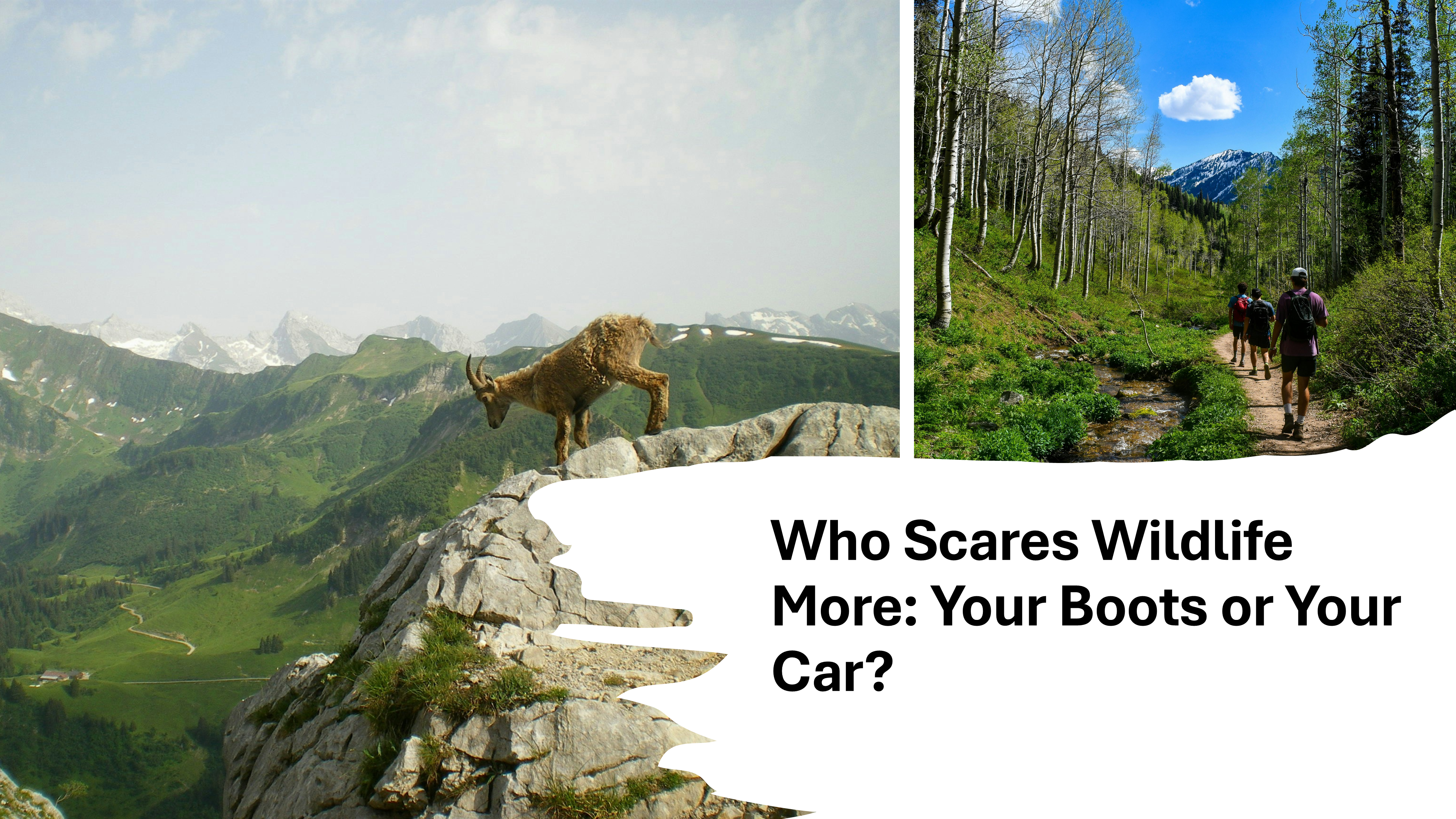
A 3-minute read for people who hike.
Most hikers carry a quiet assumption: we walk softly, we leave no trace, so we barely register to the animals around us. Cars and highways are the real problem. I believed this too, until I started reading the research. The evidence says something less comfortable. On a trail, a person on foot can unsettle wildlife more than a passing vehicle does.
Recreation affects wildlife almost everywhere it is studied
In 2016, a team from Colorado State, UC Berkeley and the Wildlife Conservation Society reviewed 274 studies on non-consumptive recreation and animals. Over 93% of the reviewed articles documented at least one effect. Those effects include animals fleeing, spending less time feeding, shifting their activity to night, and abandoning good habitat near trails.
The displacement can reach far. In Alberta’s Bow Valley, camera traps showed half of the avoidance effect of busy trails was still present 300 m away for grizzly bears and 600 m away for wolves. A follow-up review found disturbance thresholds ranging from 50 m for small rodents to 1,000 m for large ungulates.
The counter-finding: quiet feet can be worse than engines
The same 2016 review found effects were observed 1.2 times more often for non-motorized recreation than for motorized activities. That category includes hiking, trail running, skiing and climbing.
Single studies show the same pattern. In Canyonlands National Park, desert bighorn sheep reportedly fled hikers 61% of the time but motor vehicles only 17% of the time. Along Idaho’s Boise River, bald eagles flushed most often from people on foot.
The likely reason is predictability. A car stays on the road, keeps a steady speed and makes a steady noise. Animals learn that it passes and does not come for them. A hiker is quieter and slower, stops to look, points a camera and sometimes steps off the trail. To a deer or a sheep, that pattern looks a lot like a predator stalking. One study on caribou made the same point: the steady drone of snowmobiles may stress them less than silent backcountry skiers.
But speed and noise still matter
This does not mean engines are harmless. In a controlled experiment at Oregon’s Starkey Experimental Forest, elk kept the greatest distance from ATV riders. Mountain bikers came next, and hikers and horse riders caused the least avoidance. The researchers concluded that elk treat a busy recreation trail much like a road open to traffic.
A camera-trap study in British Columbia found the same order across 13 species. Every species avoided people on trails, but avoidance was strongest for mountain bikes and motorized vehicles.
Roads and trails also harm wildlife in different ways. Roads kill animals directly through collisions and cut habitat into pieces. Trails mostly displace animals, raise their stress and cost them feeding time. Both add up.
What hikers can do
The takeaway is about behaving like a car: stay predictable.
- Stay on the trail. Animals learn where people go. Off-trail wandering breaks that pattern.
- Do not stop and stare at close range. Watch from a distance and move on.
- Keep dogs leashed. Hikers with dogs disturb a wider area than hikers alone.
- Respect seasonal and dawn or dusk closures. Those hours are when many animals feed and move.
- Keep voices low. Loud talking stretches your disturbance zone well beyond the trail.
The animals have already adjusted to us. Many become more nocturnal near busy trails. The least we can do is be the kind of visitor they can predict.
References
- Larson, Reed, Merenlender & Crooks (2016). Effects of recreation on animals revealed as widespread through a global systematic review. PLoS ONE 11(12): e0167259.
- Dertien, Larson & Reed (2021). Recreation effects on wildlife: a review of potential quantitative thresholds. Nature Conservation 44: 51-68.
- Wisdom et al. (2018). Elk responses to trail-based recreation on public forests. Forest Ecology and Management.
- Naidoo & Burton (2020). Relative effects of recreational activities on a temperate terrestrial wildlife assemblage. Conservation Science and Practice.
- Bow Valley camera-trap study, Daily Hive coverage (2025).
- Summary of bighorn and eagle comparisons, NRA Hunters’ Leadership Forum (secondary source; primary papers not checked).
- Sierra Club on snowmobiles vs. skiers (secondary source).