
W2J: Porting a 40-Year-Old Fortran Reservoir Model to Julia
Published:
What does it take to modernize a scientific model that predates the engineers who maintain it? CE-QUAL-W2 is a ~45,000-line Fortran codebase USACE has used since the 1980s to simulate how reservoirs stratify, mix, and carry heat and pollutants — the kind of model a water district calls on before deciding whether it’s safe to draw drinking water downstream of a dam. This project rebuilds it from scratch in Julia, module by module, each one validated against the original source and real reservoir data before it’s trusted.
The Problem
Fortran scientific codebases like this one are everywhere in government and research infrastructure, and they share the same three limitations:
- No real parallelism. The physics is embarrassingly parallel — thousands of independent per-segment tridiagonal solves — but the original code runs single-threaded,
OMPpragmas commented out. - No differentiability. Calibrating a model like this against observed data means tuning dozens of rate coefficients by hand. A differentiable version could use gradient-based optimization instead.
- Decades of accumulated coupling. Water-quality kinetics for ~70 constituent processes are entangled with grid indexing throughout — you can’t reuse the ecology math without dragging the
(K,I)loop structure with it.
Rewriting isn’t a matter of running a Fortran-to-Julia transpiler and hoping for the best. It’s re-deriving why each subroutine does what it does, then deciding what to port faithfully, what to defer, and what to redesign — and being honest, in the code itself, about which is which.
Engineering Approach
Read the source, don’t guess
Every module here traces back to a specific Fortran file and line range, confirmed by reading the source directly — not reconstructed from documentation or memory. This discipline caught real mistakes early: an initial assumption that the transport module updates concentrations directly turned out to be wrong. Reading transport.f90 showed it only computes explicit advective flux terms; the actual implicit solve lives in a different file entirely, three call sites away, and reuses coefficients computed by yet another module earlier in the same timestep — a real sequencing dependency that would have silently produced wrong physics if assumed instead of traced.
Reduced physics, clearly flagged — not silently wrong
Faithfully porting every term in the original momentum and transport equations before anything runs end-to-end would mean months with nothing to validate. Instead, each physics module ports the real formulas for its core terms and explicitly zeroes out — and documents in the code, not just a wiki — the terms that need a not-yet-built dependency (turbulence closure, meteorology forcing). Nothing is silently approximated; every simplification is a flagged, temporary scope decision.
Validate with checks that can actually fail
A test that can’t fail isn’t a test. Correctness checks throughout this project are built to be falsifiable by a real bug, not just a smoke test:
Zero-flow sanity check:  water surface must stay bit-stable to < 1e-9
                         over a full simulated year — a bug in the
                         tridiagonal assembly shows up as drift or NaN,
                         not a false pass.

Heat conservation check: sum(T x volume) before/after a diffusion step
                         must match to machine precision — this is what
                         caught two real bugs (see below), not a
                         hypothetical edge case.
Architecture
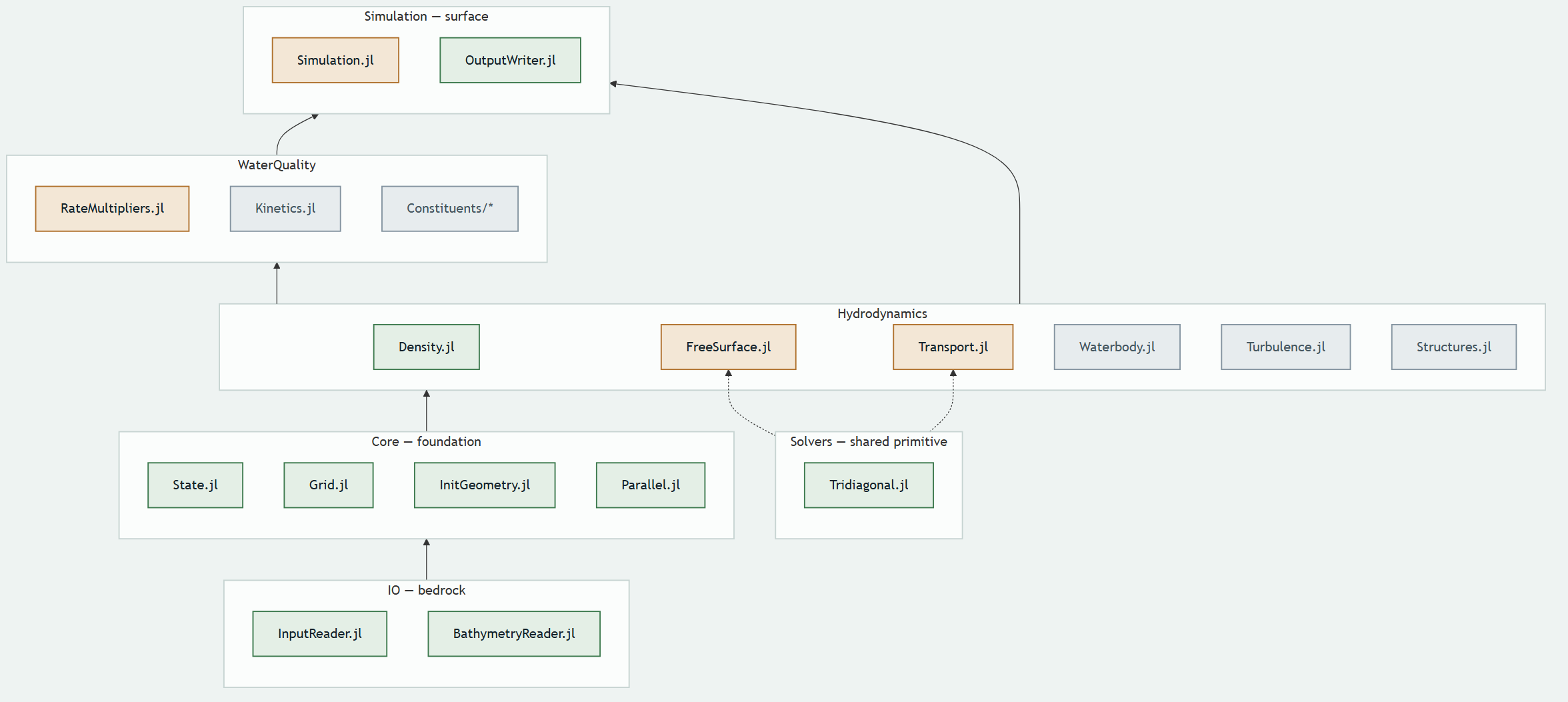
Read bottom-to-top, like a water column: input files at the bed, the physics solve through the middle depths, the timestepping driver at the surface. Green = validated against real data or known reference values. Amber = real core formulas, with specific terms deliberately stubbed and flagged rather than silently approximated. Grey = not started. Tridiagonal.jl is drawn as a shared primitive rather than another layer in the stack, since nearly every physics module reaches into it directly.
Bug Found: A Real Regression, Not a Hypothetical
Parallelizing the free-surface solve with Threads.@threads was correct on the first pass — bit-identical output confirmed at 1 and 4 threads. But wall-clock time hadn’t been checked, and when it was, naive threading made the hot loop 3.6x slower, not faster:
| Threads | Naive threading | After fix |
|---|---|---|
| 1 | 0.136 ms/step | 0.14 ms/step |
| 8 | 0.484 ms/step | 0.20 ms/step |
The grid is small enough that Threads.@threads’s own spawn overhead outweighed the actual per-column work. The fix — a parallel_foreach that only threads above an empirically benchmarked size threshold, picked serial vs. threaded per call — recovered the 1-thread baseline at every thread count, while still threading automatically once a grid is large enough to benefit. Nobody profiles a fix like this without first measuring that the “obvious” optimization made things worse.
Bugs Found: Heat Was Leaking Through the Boundaries
Adding temperature transport meant validating that heat is actually conserved under pure diffusion — no sources, no flow, so total heat should be exactly constant. It wasn’t. Two rounds of debugging traced it to the same root cause at both ends of the water column: the raw bathymetry array is genuinely nonzero above the current water surface and at the lakebed (it reflects the reservoir’s full physical shape, not where the model currently truncates it). A uniformly-filled diffusivity field was coupling active layers to phantom cells above the surface and below the bed.
| Check | Before fix | After fix |
|---|---|---|
| Single-step heat conservation | ~24% loss over 3,000 steps | ~1e-16 relative (machine precision) |
| Sharp temperature step profile | didn’t reach expected equilibrium | smooths exactly as diffusion predicts |
Results
| Metric | Value |
|---|---|
| Test suite | 498/498 passing, at 1 and 4 threads |
| Full simulated year (26,208 timesteps) | ~2.7 seconds, drift < 1.2e-10 |
| Heat conservation (post-fix) | ~1e-16 single-step, ~1e-13 over 3,000 steps |
| Threading regression recovered | 3.6x slowdown → parity or better at every thread count |
| Fortran source read directly | ~45,000 lines across the modules ported so far |
Tech Stack
- Language: Julia 1.11
- Parallelism:
Threads.jlwith an empirically-tuned, size-adaptive dispatch (parallel_foreach) - Numerics: Custom Thomas-algorithm tridiagonal solver, shared across every module that needs it
- Planned:
Enzyme.jlfor gradient-based calibration (drove the “no global mutable state” design constraint from day one) - Tooling: Standalone Excel→YAML control-file converter, a ported subset of the reference model’s own input-validation preprocessor
- Reference: Original CE-QUAL-W2 Fortran source (USACE), validated line-by-line
Key Takeaways
Reading the source beats guessing every time. Two of the most important findings in this project — a real cross-module sequencing dependency and two boundary-condition bugs — were only catchable by tracing the actual Fortran, not by working from documentation or a plausible mental model.
“It’s correct” and “it’s fast” are different claims. The threading regression shipped as correct — bit-identical output, passing tests — while quietly being slower than no threading at all. Only measuring wall-clock time surfaced it.
A test that can’t fail isn’t validation. The zero-drift and heat-conservation checks weren’t chosen for convenience; they’re the specific checks a real bug in the physics would visibly break.
Ongoing project — currently validated against real Detroit Reservoir (Oregon) data, with water-quality kinetics, meteorology forcing, and a full Fortran reference-output comparison still ahead.